Grooming an anxious dog without making the fear worse
An anxious dog can learn to accept grooming, but not by being held down until it's over. Slow, short, predictable sessions build the trust that force destroys.
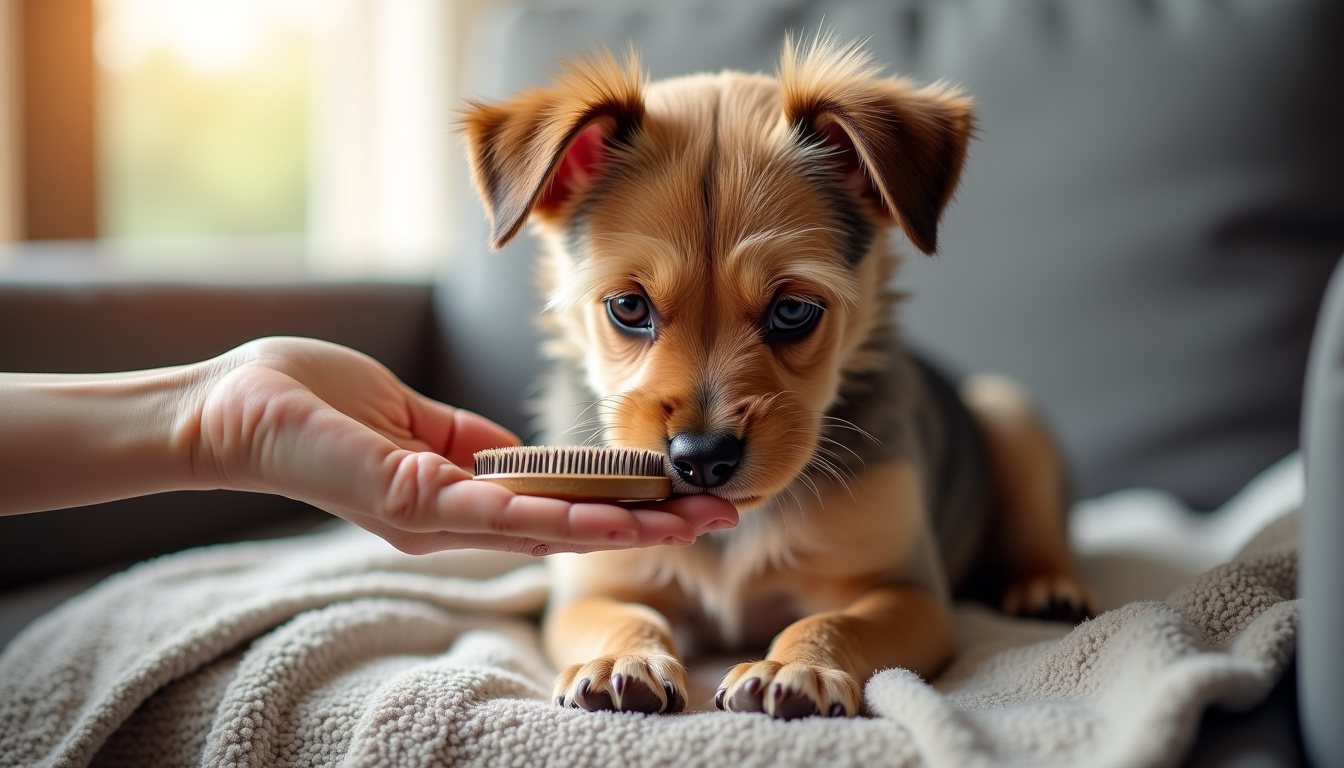
Some dogs dislike grooming mildly; they wriggle or walk off. Others are genuinely frightened: they hide when the brush comes out, shake in the bath, or snap when you reach for a paw. Fear like that usually has a history behind it, such as painful mats being pulled, a quicked nail, being held down, or simply never having learned that handling is safe.
The approach that works is the same whatever the cause: make each step small enough that your dog stays relaxed, pair it with something good, and build up slowly. This guide explains how, and when it's time to bring in help.
If your dog has bitten or tried to bite during grooming, or if fear seems to be getting worse, please talk to your vet. Pain and medical problems are a common reason for sudden grooming resistance, and your vet can refer you to a veterinary behaviorist or experienced positive-reinforcement trainer if needed.
Learn your dog's stress signals
Dogs usually tell us they're uncomfortable long before they growl. Watch for:
- Lip licking, yawning, or a sudden shake-off when not wet
- Turning the head away, avoiding eye contact, or "whale eye" (showing the whites of the eyes)
- Ears back, tail low or tucked, body lowered
- Panting when it isn't hot, trembling, or sweaty paw prints on the table
- Freezing or going very still
- Moving away, hiding, or mouthing your hand or the tool
- Growling, lifting a lip, snapping
The early signals are the useful ones. When you see them, stop, back off to an easier step, and end on something your dog is comfortable with.
Desensitization and counterconditioning, in plain words
Desensitization means exposing your dog to a tiny, manageable version of the scary thing, so small that it doesn't trigger fear, then making it very gradually bigger. Counterconditioning means pairing that exposure with something your dog loves, usually food, so the brush or clippers start to predict good things.
Done together, they change how your dog feels about grooming, not just how they behave. The key is that your dog stays under their fear threshold. If your dog is panicking, they aren't learning anything except that grooming is frightening.
A step-by-step example: brushing
- Brush lying on the floor. Your dog looks at it: treat.
- Pick up the brush. Treat. Put it down.
- Move the brush toward your dog and away again. Treat.
- Touch the back of the brush (not the bristles) to your dog's shoulder for a second. Treat.
- One gentle stroke on the shoulder. Treat.
- Two strokes. Treat. Then gradually more strokes and other body areas.
Each step might take one session or ten. If your dog shows stress, go back a step. The same ladder works for nail clippers, ear handling, the dryer, the bath and clippers. See trimming dog nails safely for a nail-specific version.
Make sessions short and predictable
- Short: a minute or two is a good session for an anxious dog. Stop while things are going well.
- Same place, same routine: a non-slip mat, the same spot, the same order of events.
- Choice: let your dog approach and leave. Many trainers teach a "chin rest" on a cushion or your hand as a signal that the dog is ready; when the chin lifts, you pause. This gives the dog some control and often reduces fear quickly.
- High-value rewards: small, soft, tasty treats. A lick mat with a smear of something spreadable can keep a dog happily occupied for gentle brushing.
- Calm timing: after a walk and a toilet break, not when your dog is wound up or you're in a hurry.
Reduce what makes grooming unpleasant
- Prevent mats with frequent short brushes, so you never have to pull hard. See dog brushing by coat type.
- Use the right tools gently; a slicker dragged hard hurts.
- Non-slip surfaces in the bath and on tables. Slipping is frightening.
- Warm water and a quiet dryer setting; see bathing a dog at home.
- Split jobs up: one paw today, another tomorrow.
Muzzle training as a safety tool
For dogs who have bitten or might, a basket muzzle taught positively makes handling safer for everyone, including at the vet and groomer. Introduce it like any other tool: treats from inside the muzzle, then the nose in for a second, then buckling it briefly, building up over many sessions. A well-fitted basket muzzle lets a dog pant and take treats. A muzzle is not a licence to push past fear; it's insurance while you work below it.
When to stop
Stop the session if your dog:
- Growls, snaps, or freezes stiffly
- Is panting hard, trembling or trying hard to escape
- Seems to be in pain in a particular area
Ending a session isn't giving in. A dog pushed past their limit learns that warnings don't work, and the next reaction may be stronger. Never punish growling.
If a necessary task can't wait, such as a mat that's hurting or a nail that's cracked, it's usually better to let a vet or experienced groomer handle it than to force it at home.
Working with professionals
Your vet is the first stop for a dog with significant grooming fear. They can check for pain, discuss whether medication might help (that is a decision only a vet can make, with their own dosing), and suggest a behavior professional. Some groomers specialize in nervous dogs, offer quiet one-to-one appointments, or work at the dog's pace over several short visits. Our guide to choosing a professional groomer includes questions to ask about handling and restraint.
And if you have a young puppy, now is the best time to prevent all this. See introducing a puppy to grooming.